Slides that start dressed. Ask your agent for as many as you want, and every one of them lands on the grid, in your type and your color, ready to present.


The story is yours. The order, the argument, the line that has to land: you keep deciding all of it, and what you hand over is the making. Ask for the slide and your agent builds it inside your system while you keep saying what the deck says.
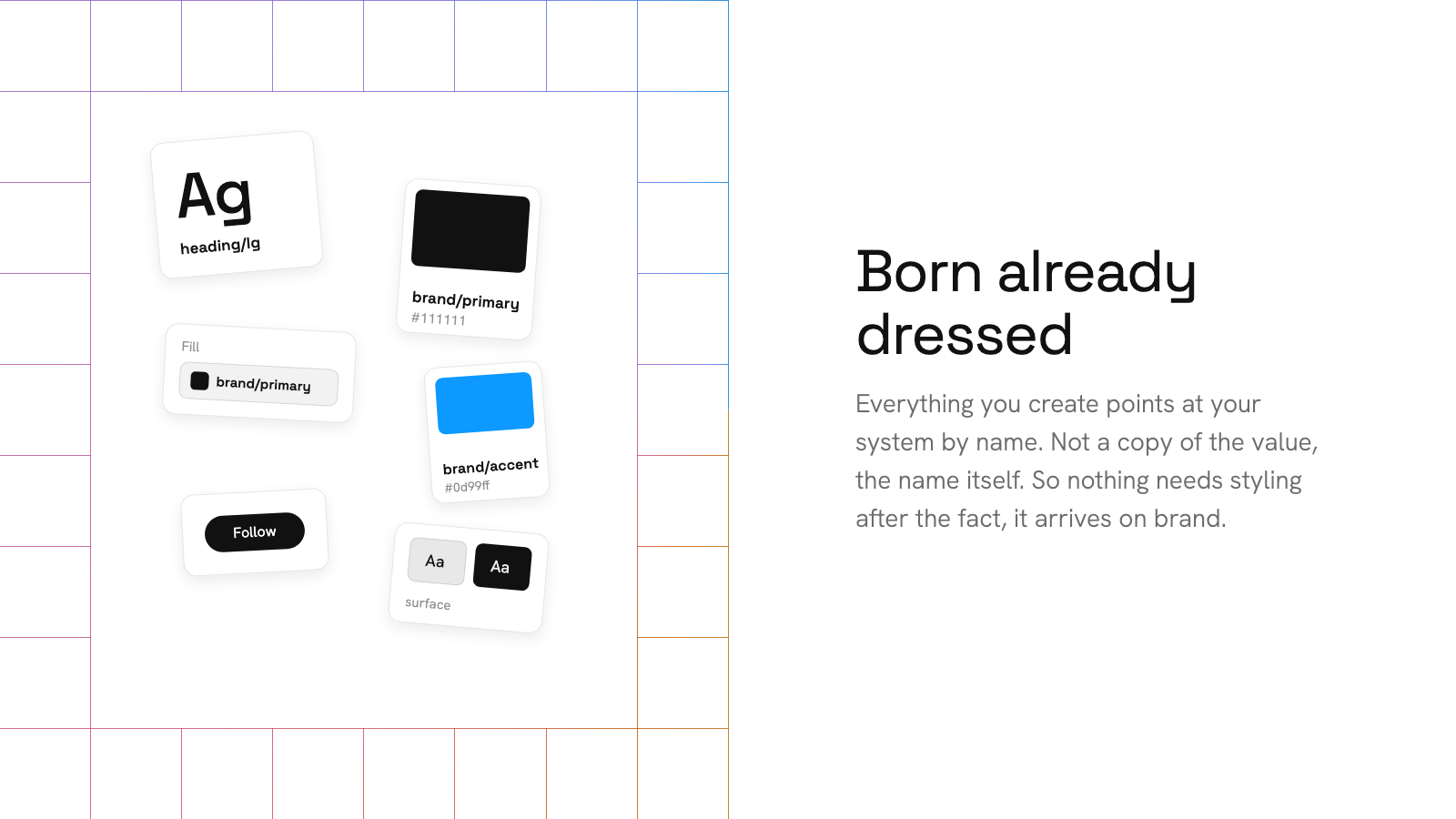
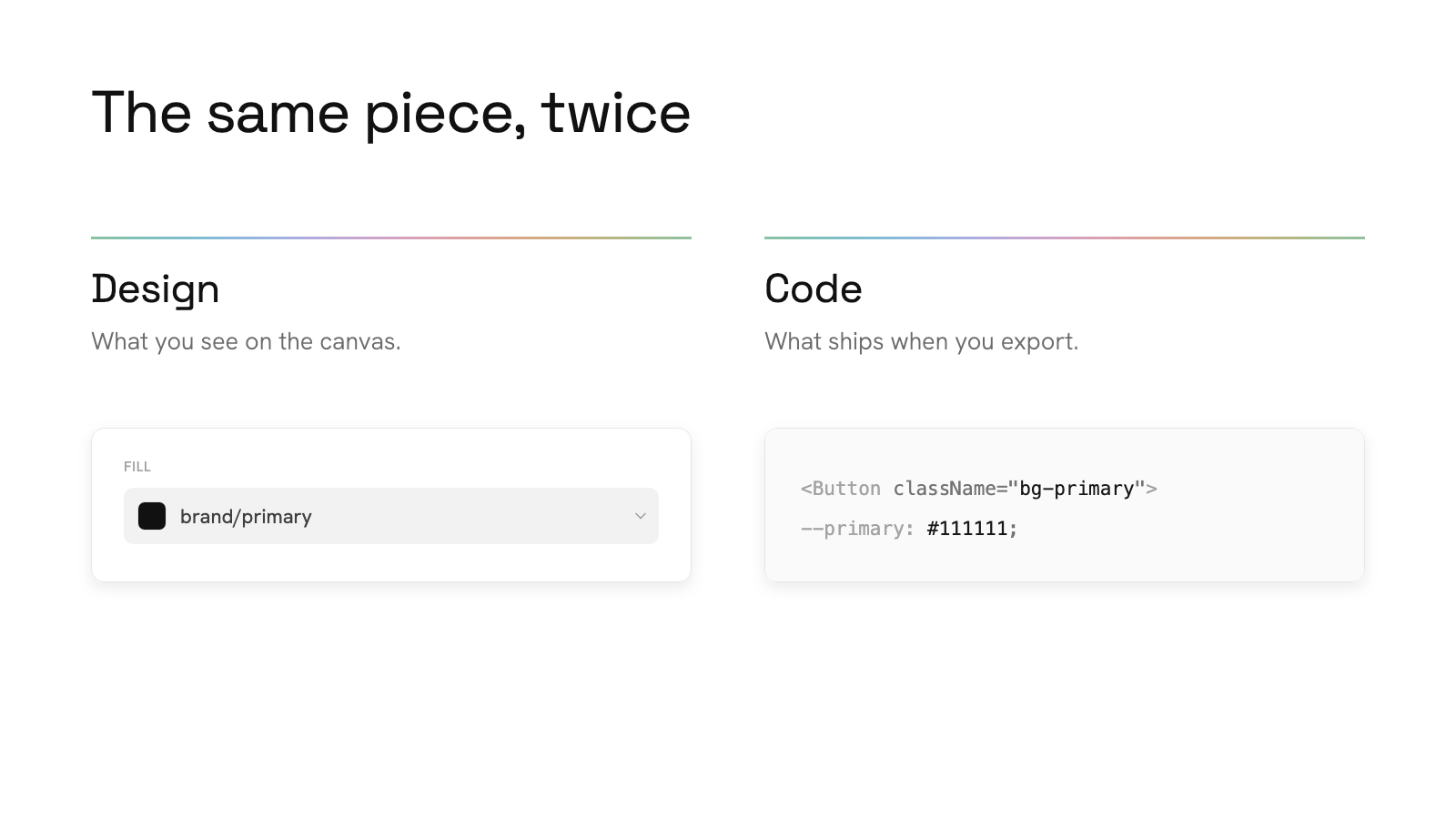
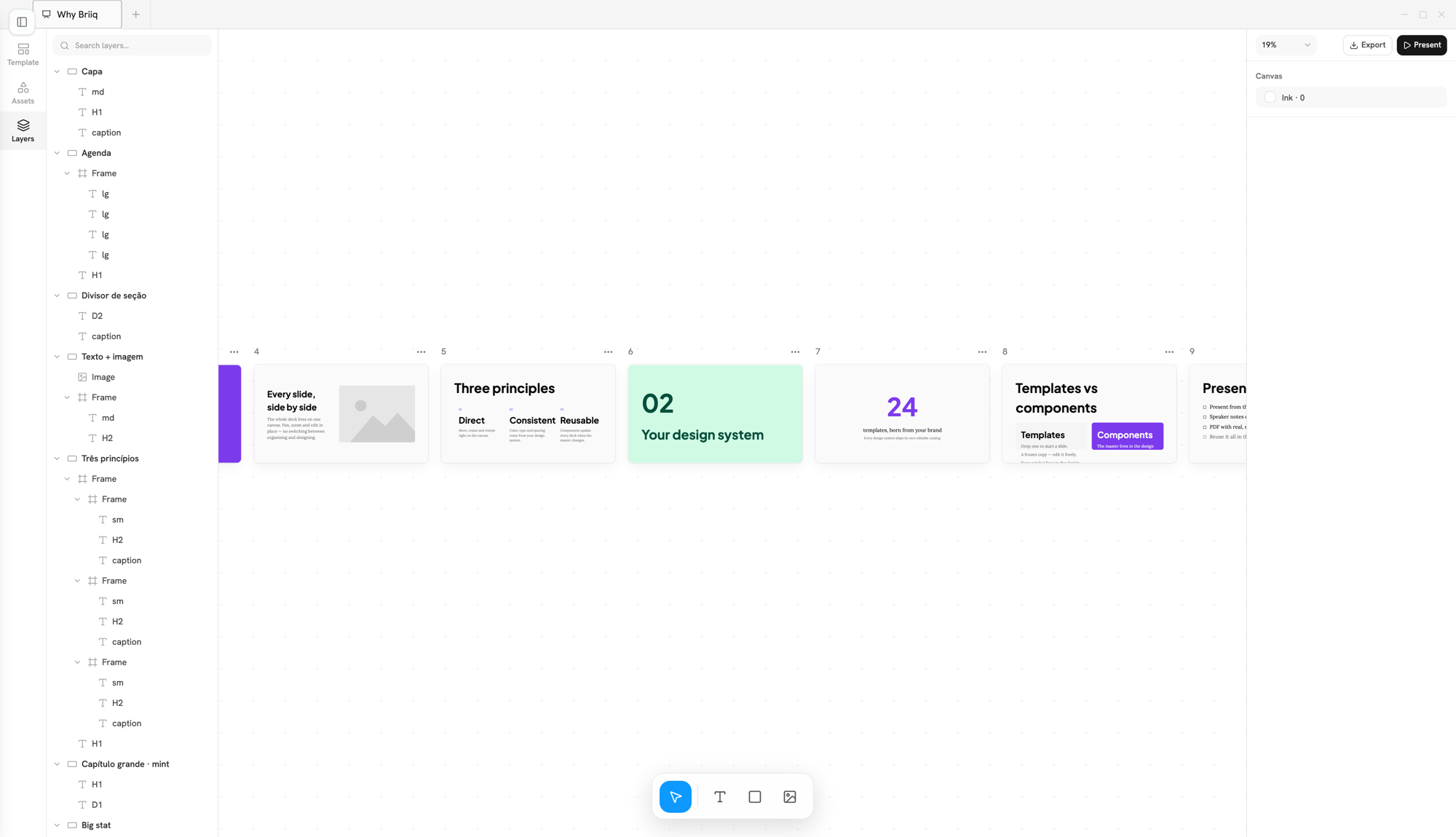
Every piece on the slide points back at your design system: a heading variant, a color role, a corner token, a theme. The piece keeps the name, and the value stays where you defined it.

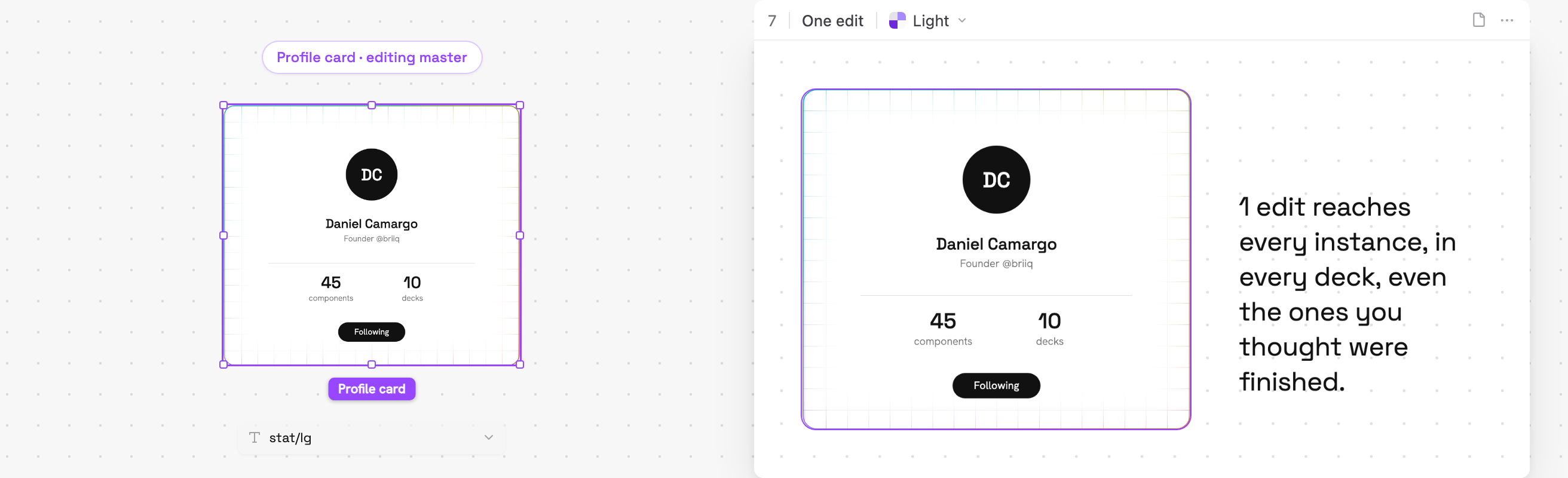
Edit the master once and every instance goes with it: the deck open in front of you, the one from last quarter, the one you thought was finished. Everything changes in one place, and every slide that shows that card is already showing the new one.

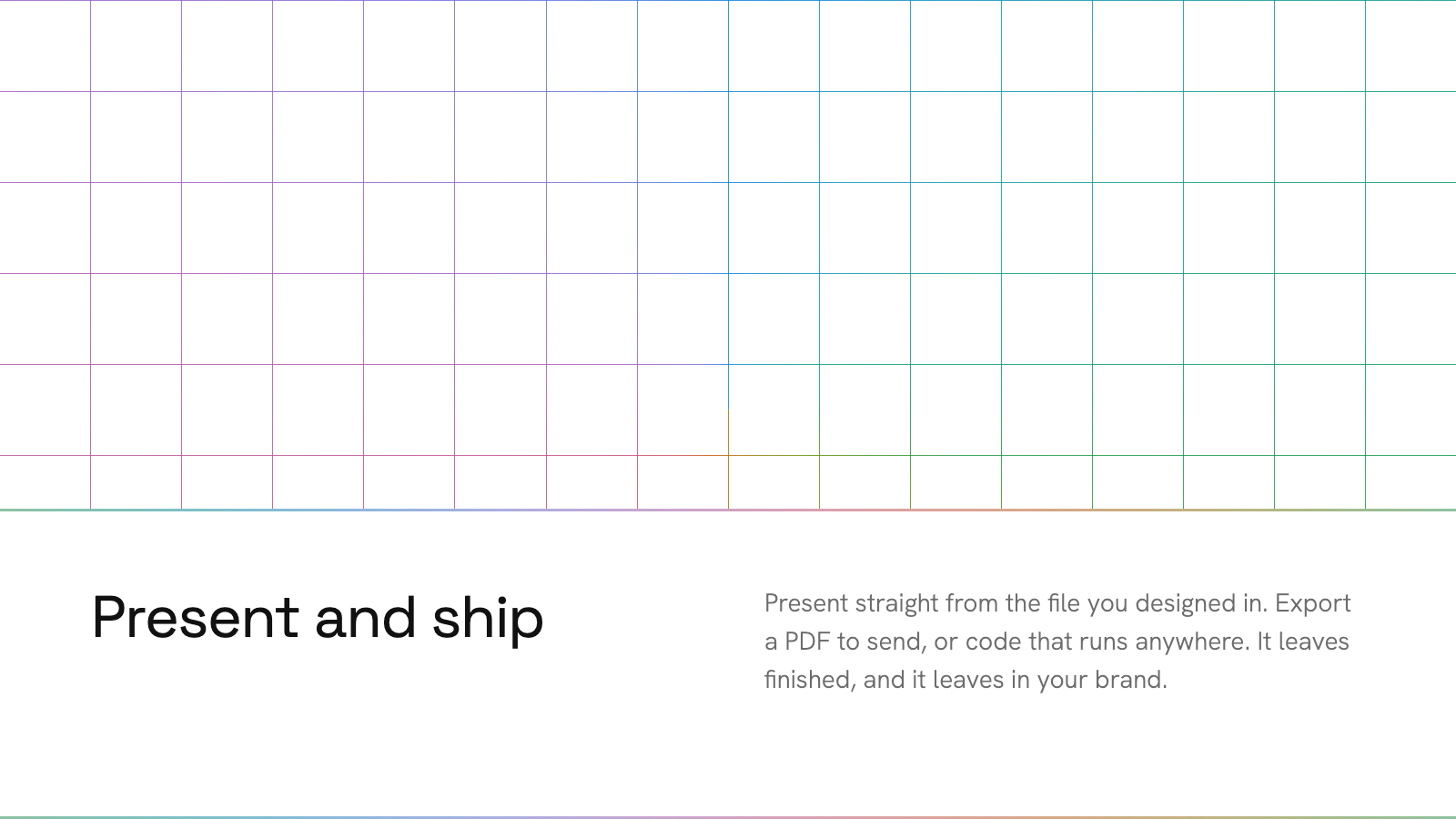
Present from the same file you designed in, with your notes and the clock on your own screen. When it is over, you can export as a PDF or as code you open in whatever IDE you want.

Try it on your own brand. Sign up, bring in the material you have, whatever shape it is in, and make something real with it today. What comes out is yours from the first slide, and you can put it in front of someone the same afternoon.
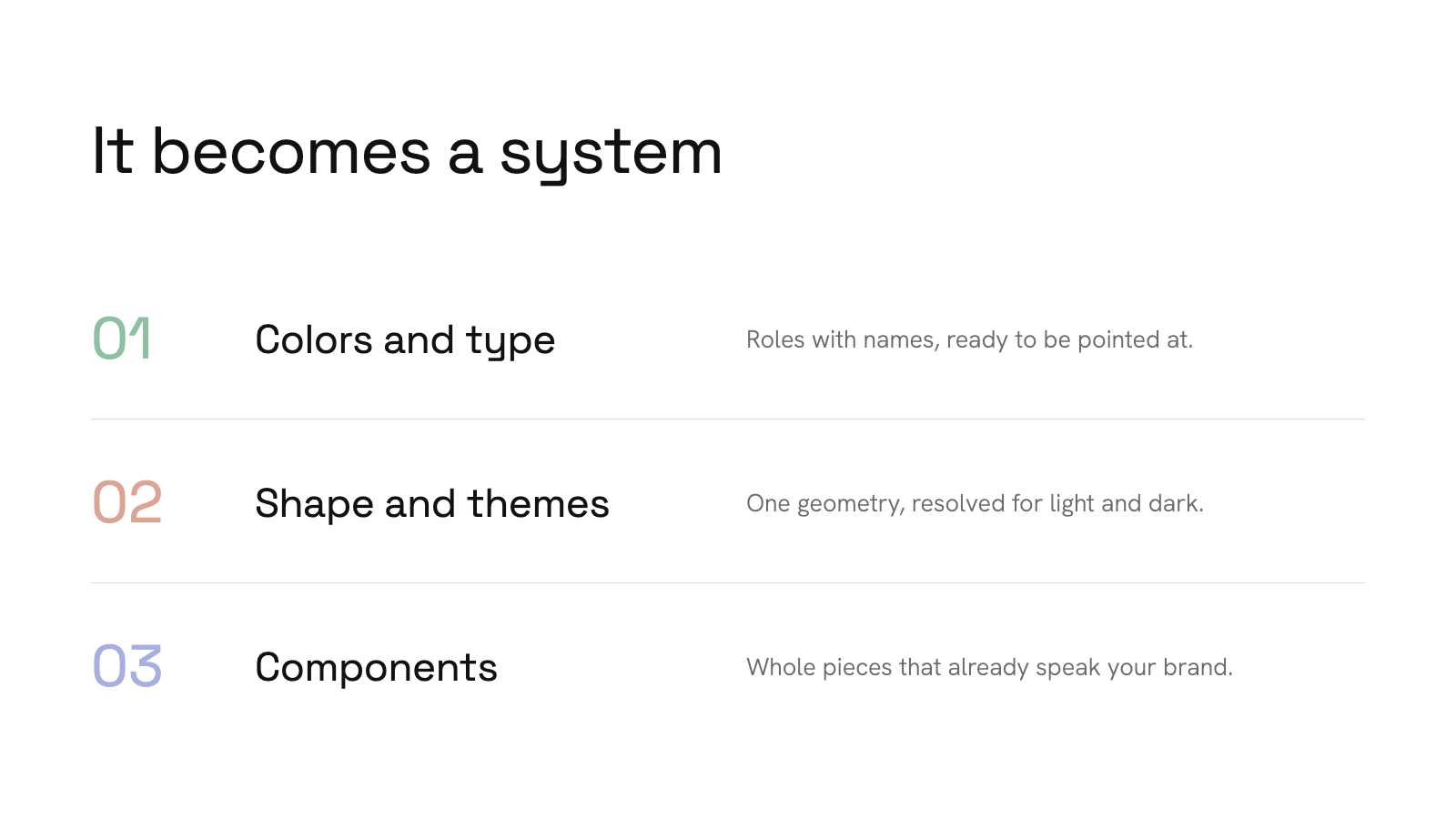
The place your brand becomes a system: colors, type, shape, themes and components. Bring whatever material you already have, in any format, and Briiq reads it.

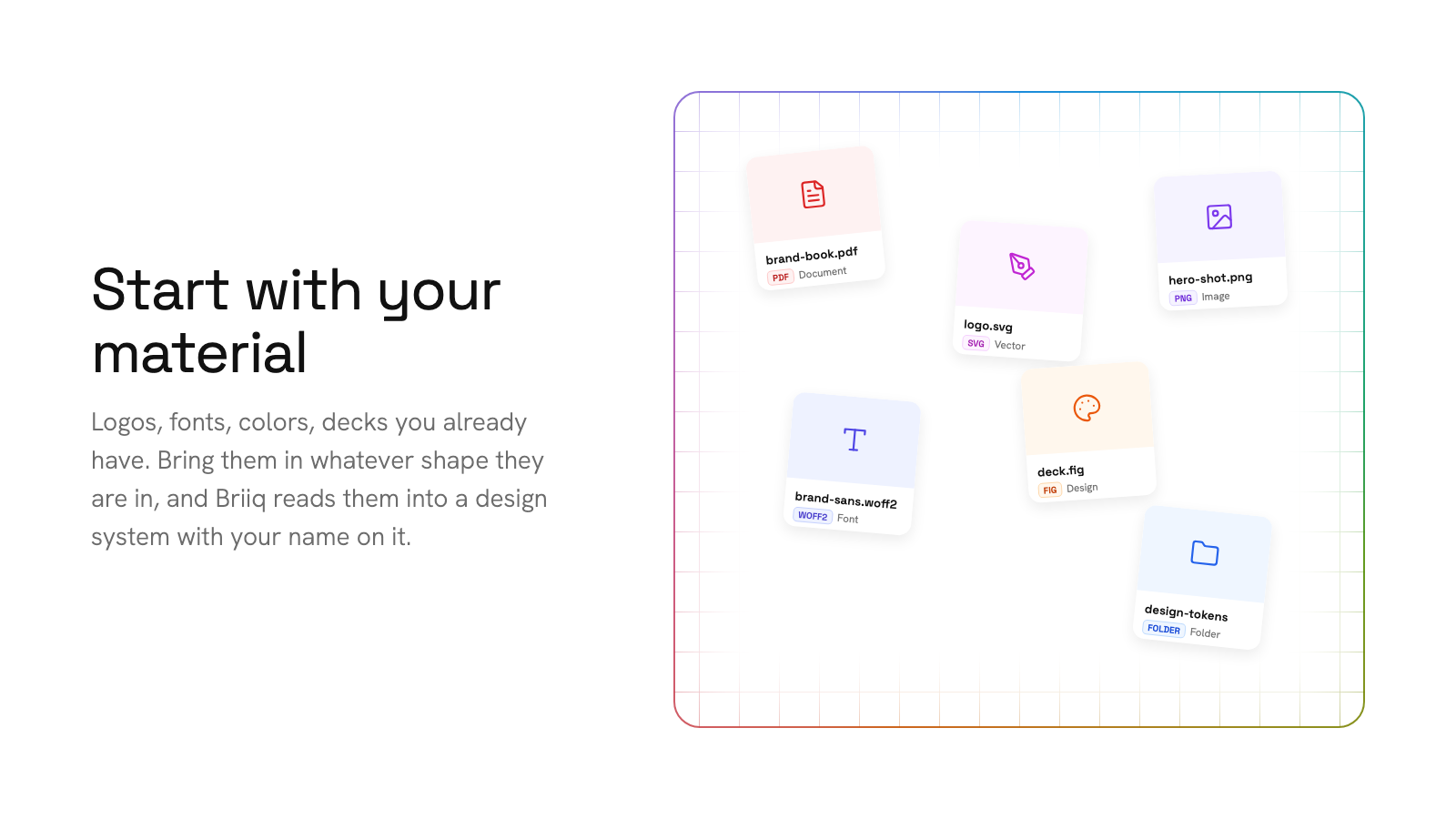
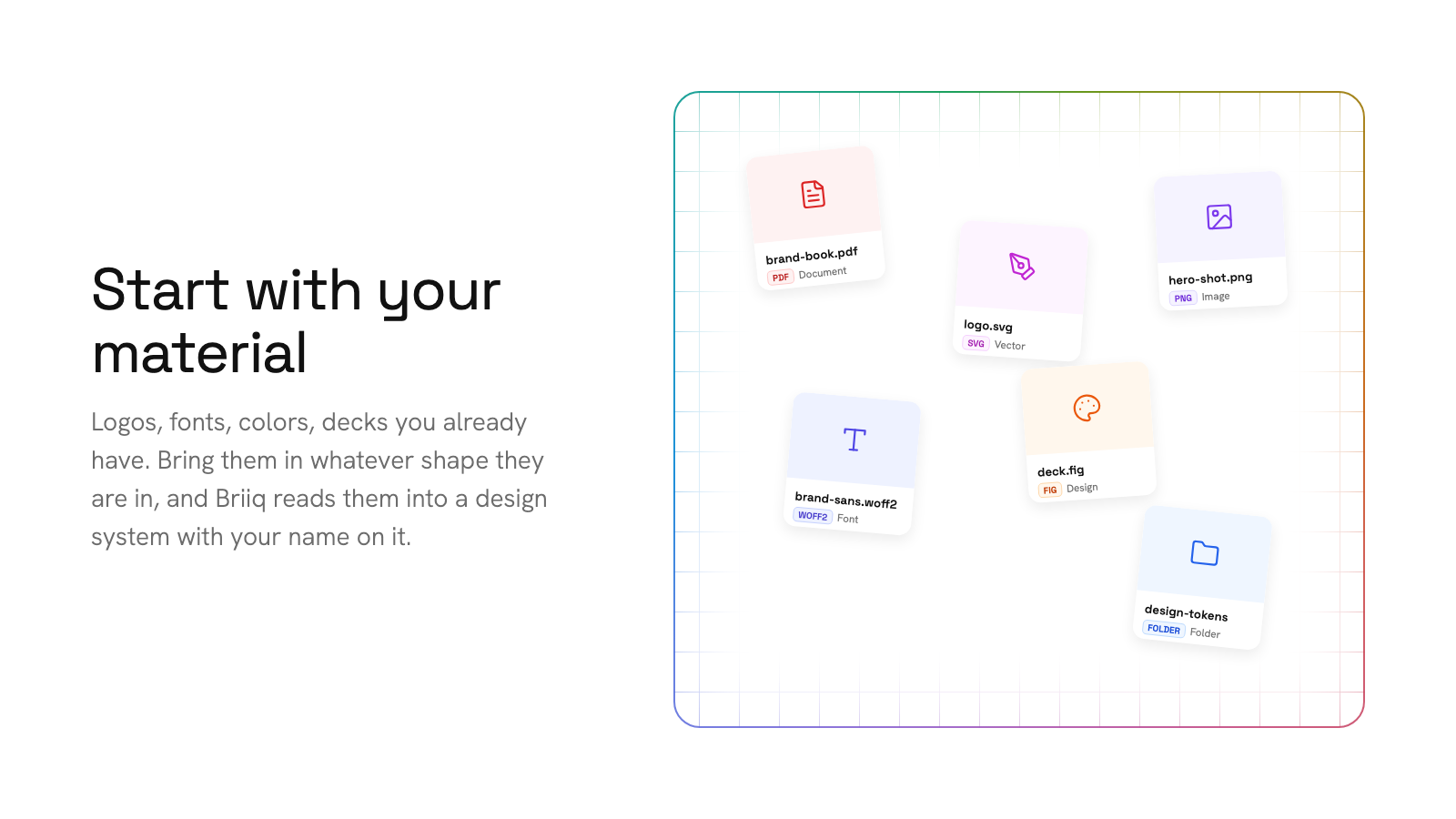
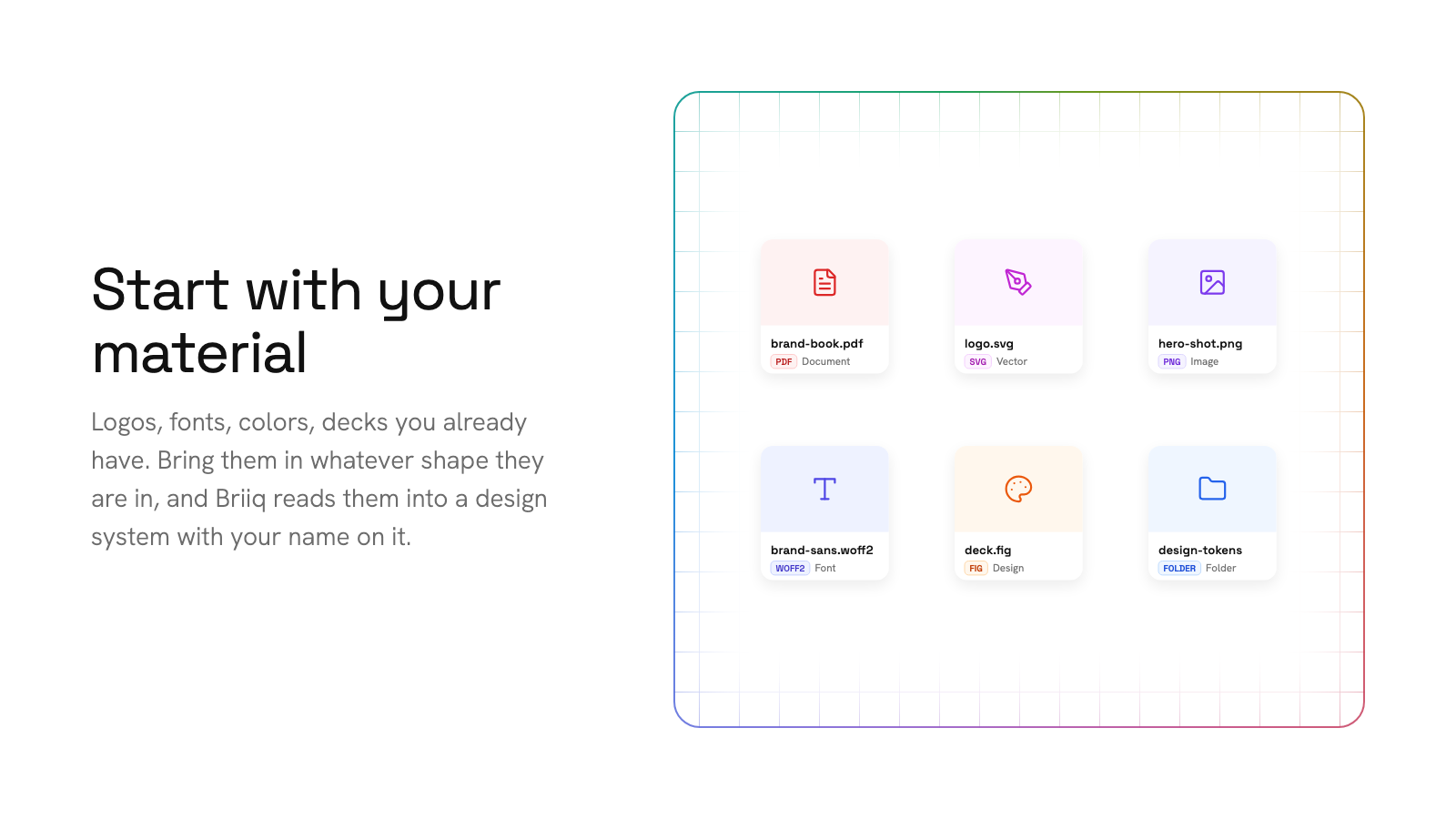
Bring the brand you already have, in whatever shape your company keeps it in. The book, the library, the tokens, the files that already carry it: all of it goes in, and what comes back is the complete design system of your brand, live inside Briiq from that day on.
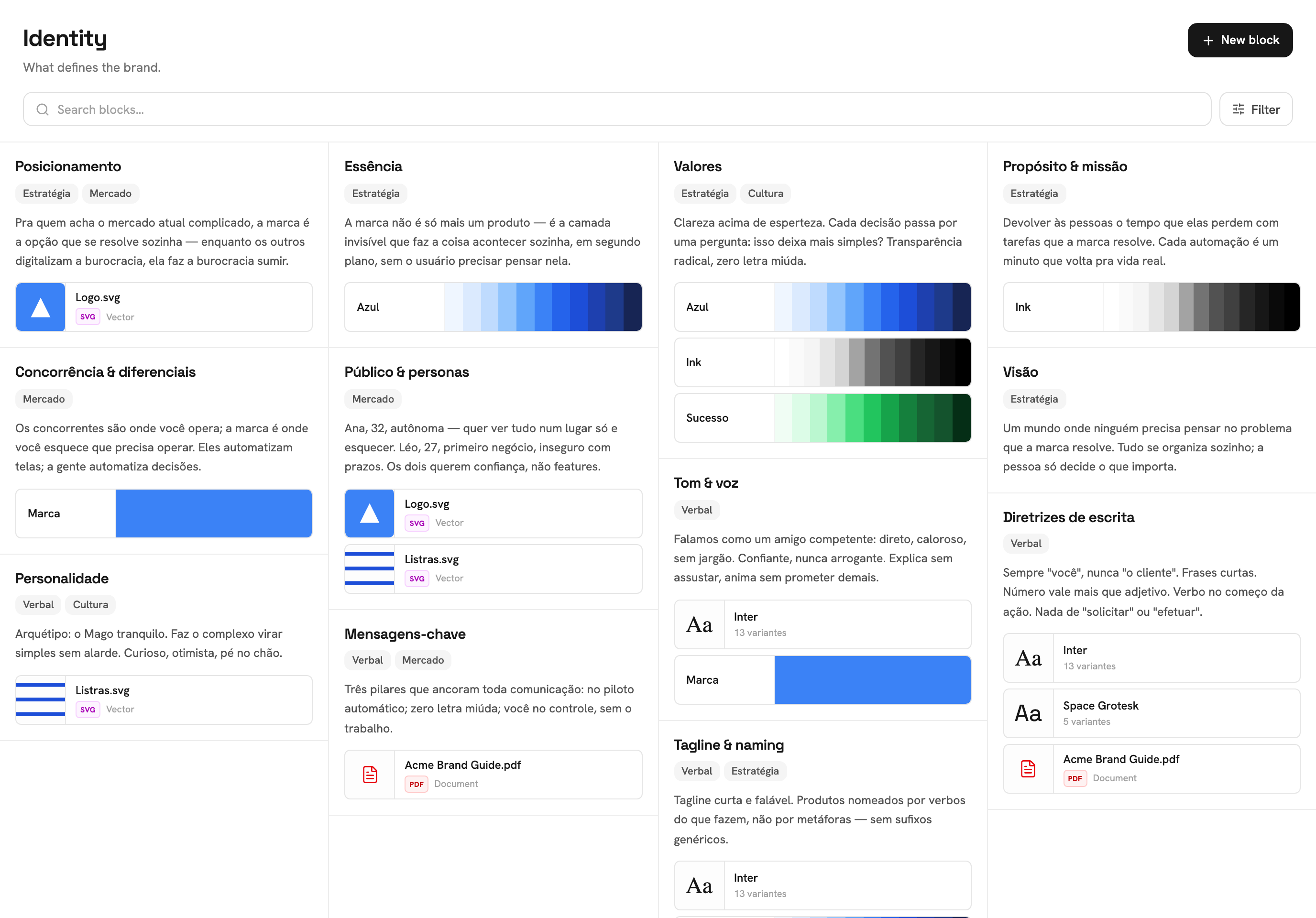
Each area here is a part of the brand that a company really has, and that usually lives somewhere else: the writing in one file, the colors in another, the components with whoever built them. In Briiq they sit in one system, in one shape, in one place.


Everything Briiq took from your material, written down in blocks: what you stand for, how you speak, who you speak to. It is the brand knowledge the rest of Briiq works from.
The brand as files: logos, images, vectors, the fonts themselves. Here they stop being attachments somebody sends and become things the work picks up on its own.
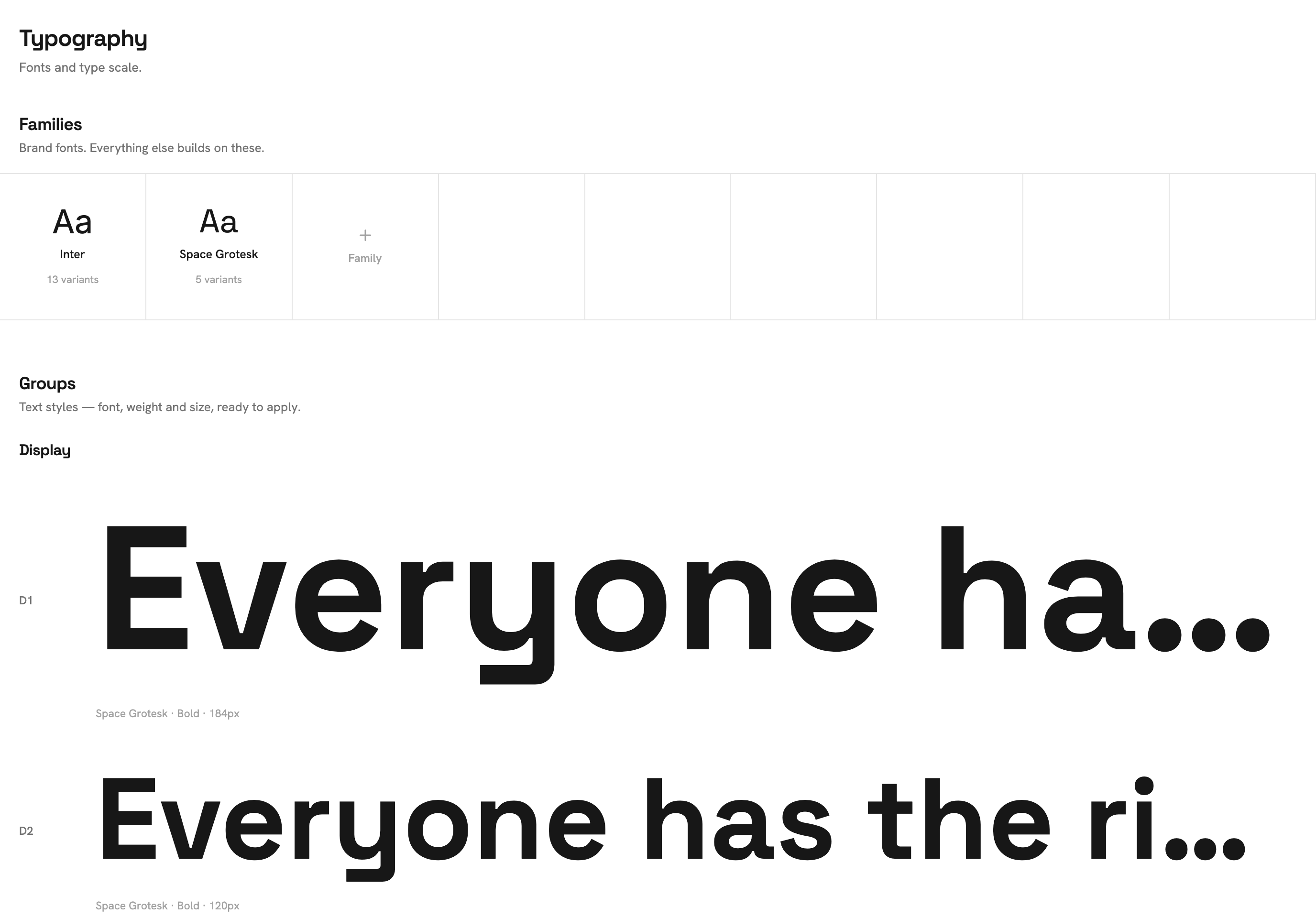
Your font families come in whole, and Briiq builds the scale from them and from the rest of your material: display down to caption, each step already sized the way your brand sets type.
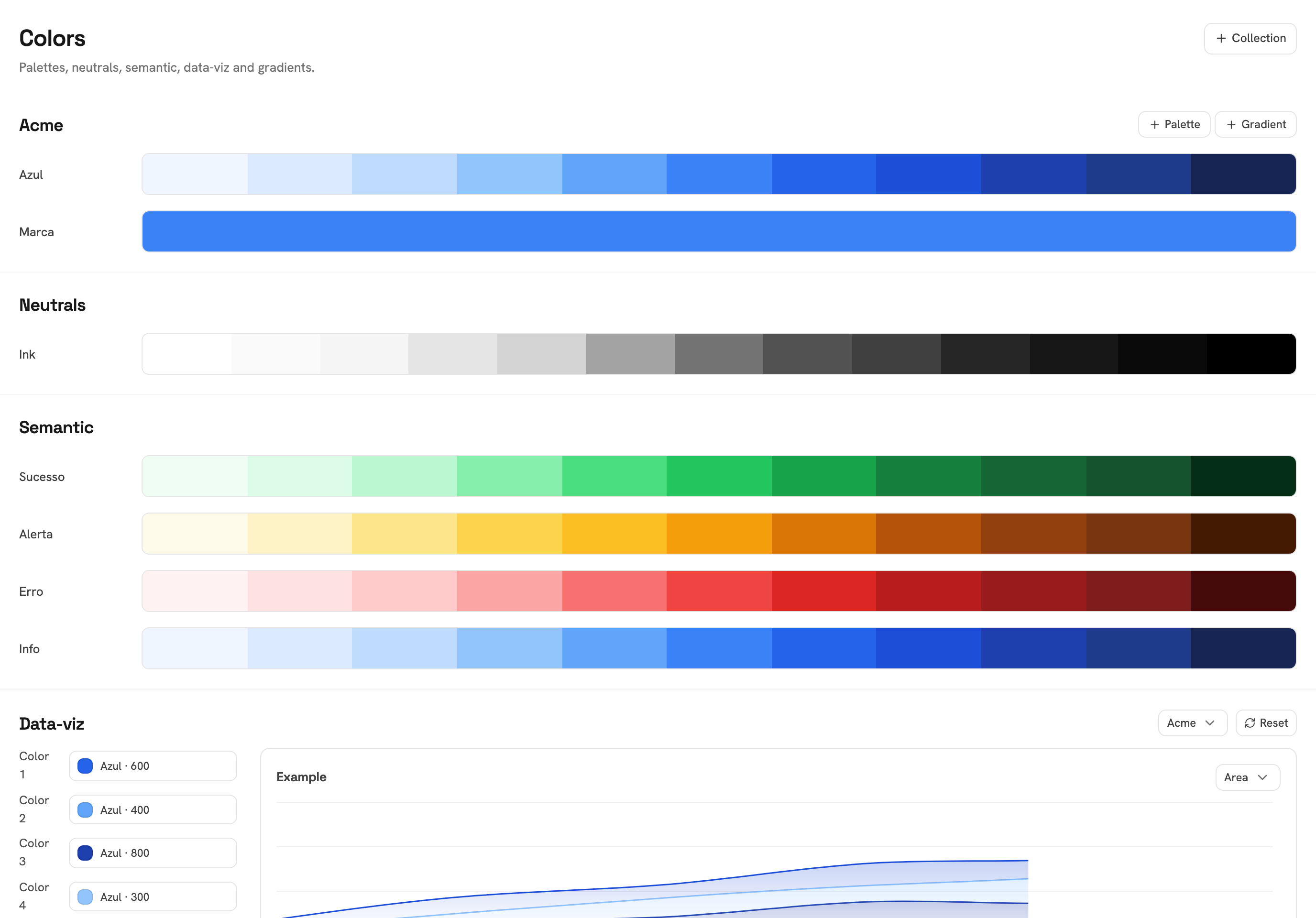
Everything a surface can be filled with, in your brand: the color palettes, the neutrals, the semantic colors, and the gradients and shaders it covers things in.
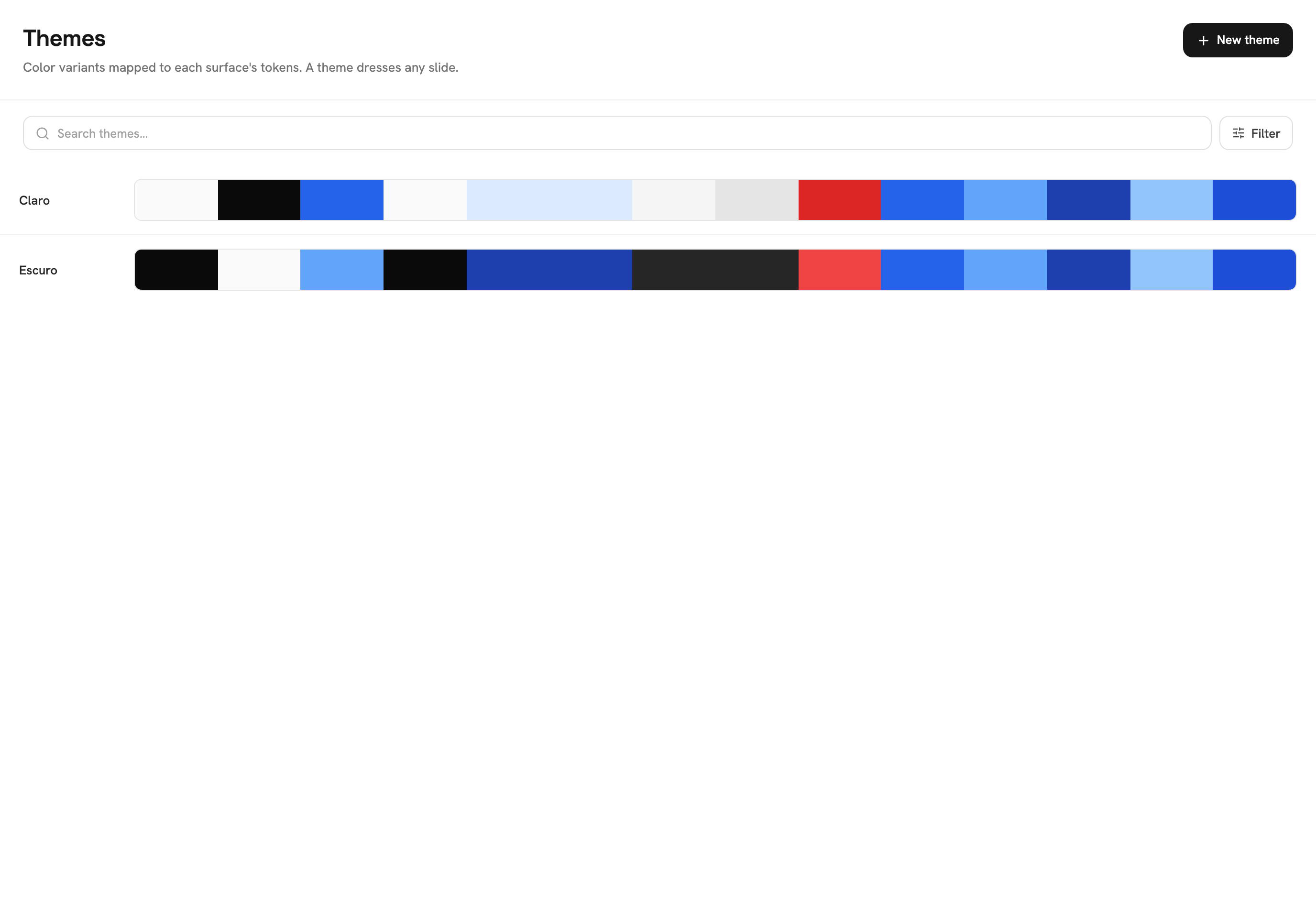
Light, dark and whatever else your brand runs, each one a full set of shadcn tokens. The same theme dresses a slide here and a screen in your codebase, with nothing in between.
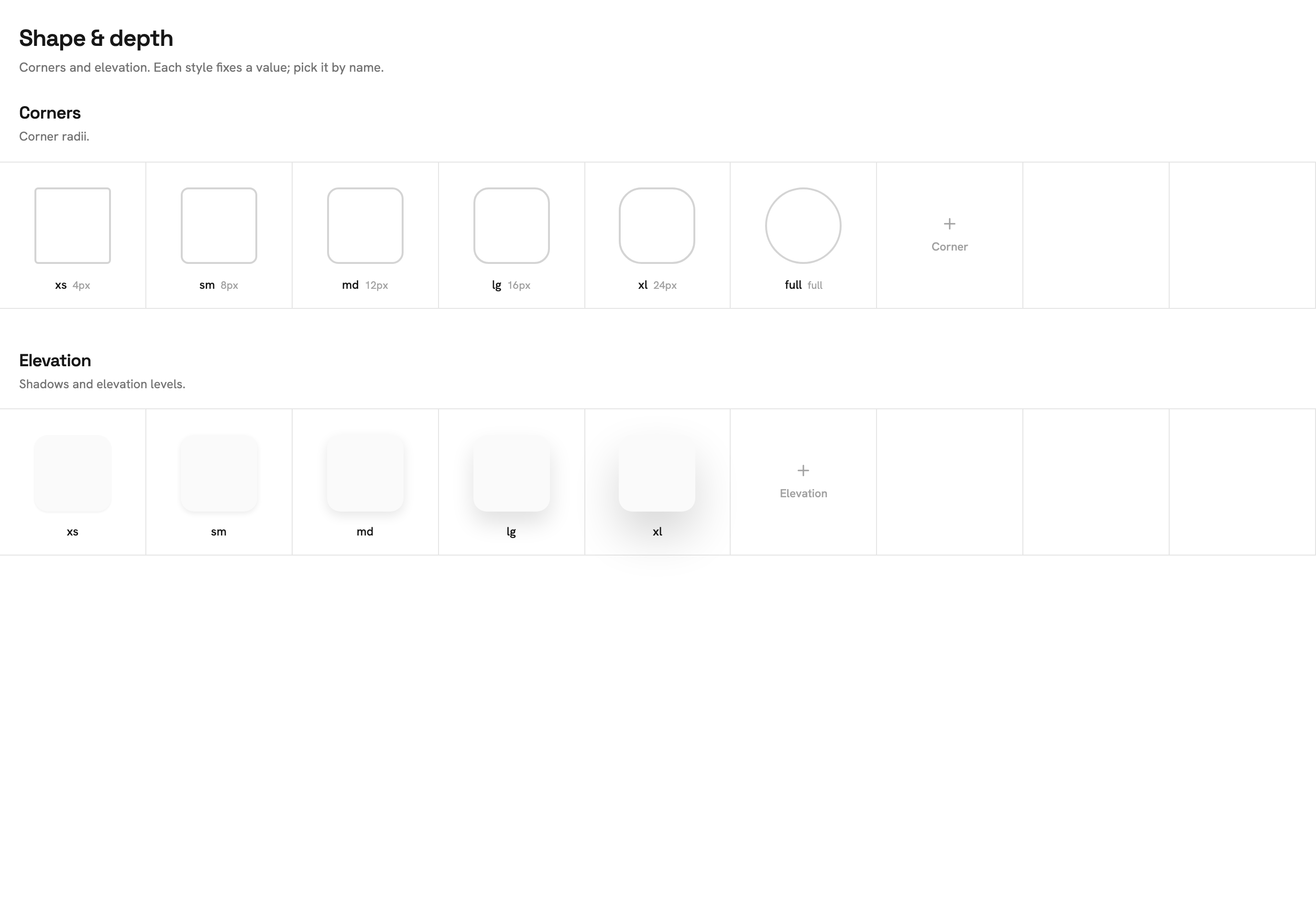
Corner radius, drop shadow, inner shadow, noise. Whatever a surface carries, your brand sets it here, and the system goes down to the grain instead of stopping at the color.
Your own icons live here, and the full Lucide catalog comes with them. Whatever a piece needs, there is already a glyph in your system for it, drawn to the same rules.
Every block of brand knowledge came from something. This is where that something lives: the brand book, the guidelines, the manuals, kept exactly as you handed them over.
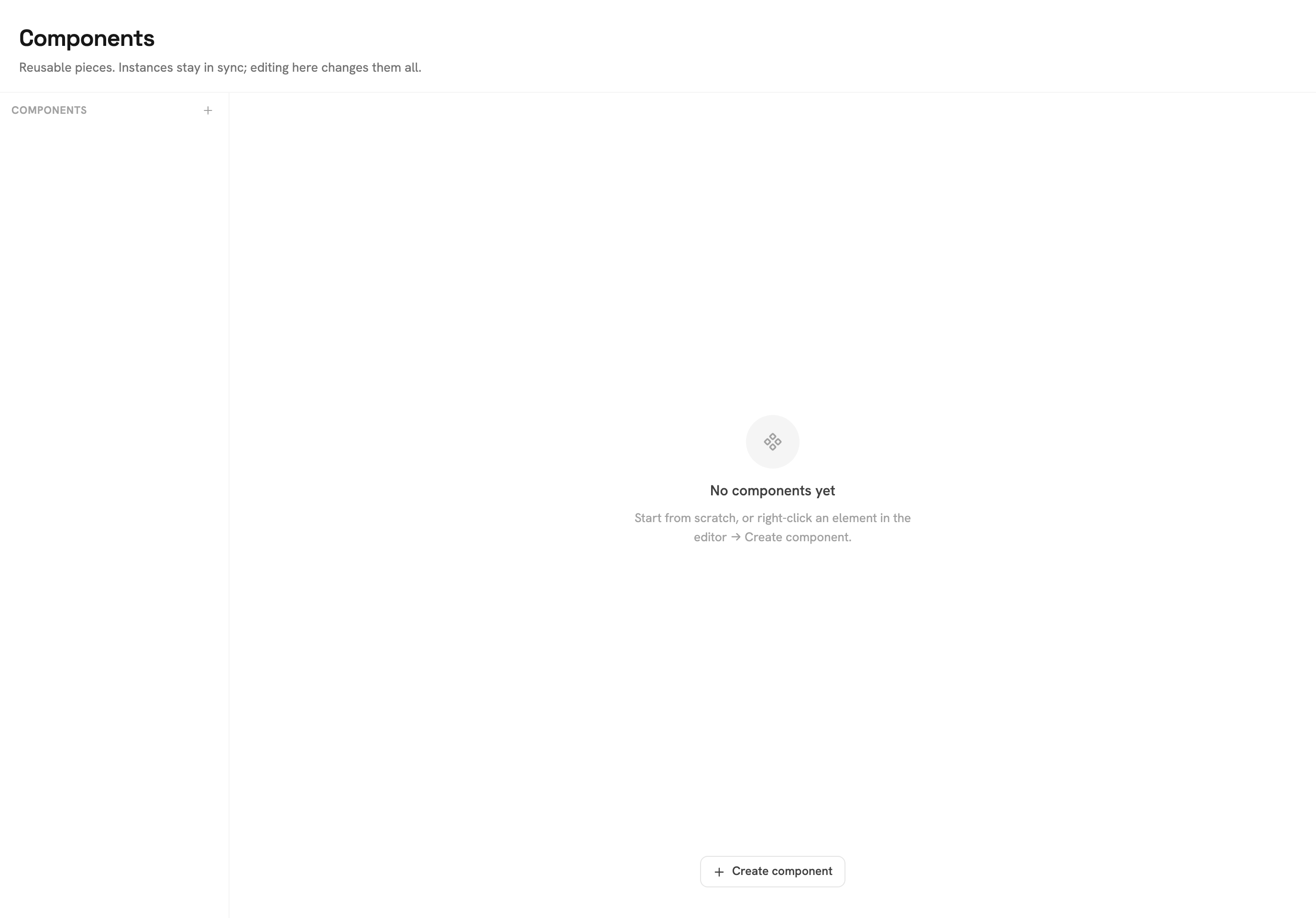
Every piece here is a shadcn component, and moving one on the canvas is editing the node itself. The design and the code are one object, not two versions of it.
The layouts a slide can start from, all of them built out of your system. Copy one and the slide is yours from then on: changing the template later leaves finished decks alone.
The agent you already pay for, working inside your brand. Briiq hands it your design system and the rules that come with it, so what it builds lands right the first time.

You already pay for a coding agent. Bring it in and it works from inside Briiq, on your own account and on the real material, so everything it builds comes out in your brand, from the first line.
One of them does the building. The other knows what to build against: your design system, and the way everything in Briiq is put together. You bring the first one with you. The second is already here, holding everything before your first prompt even lands.
Every request takes the same path. Your words get read against your brand and turned into instructions your agent can build from, in the terms your design system already uses. It builds, the work gets checked, and it shows up in front of you.
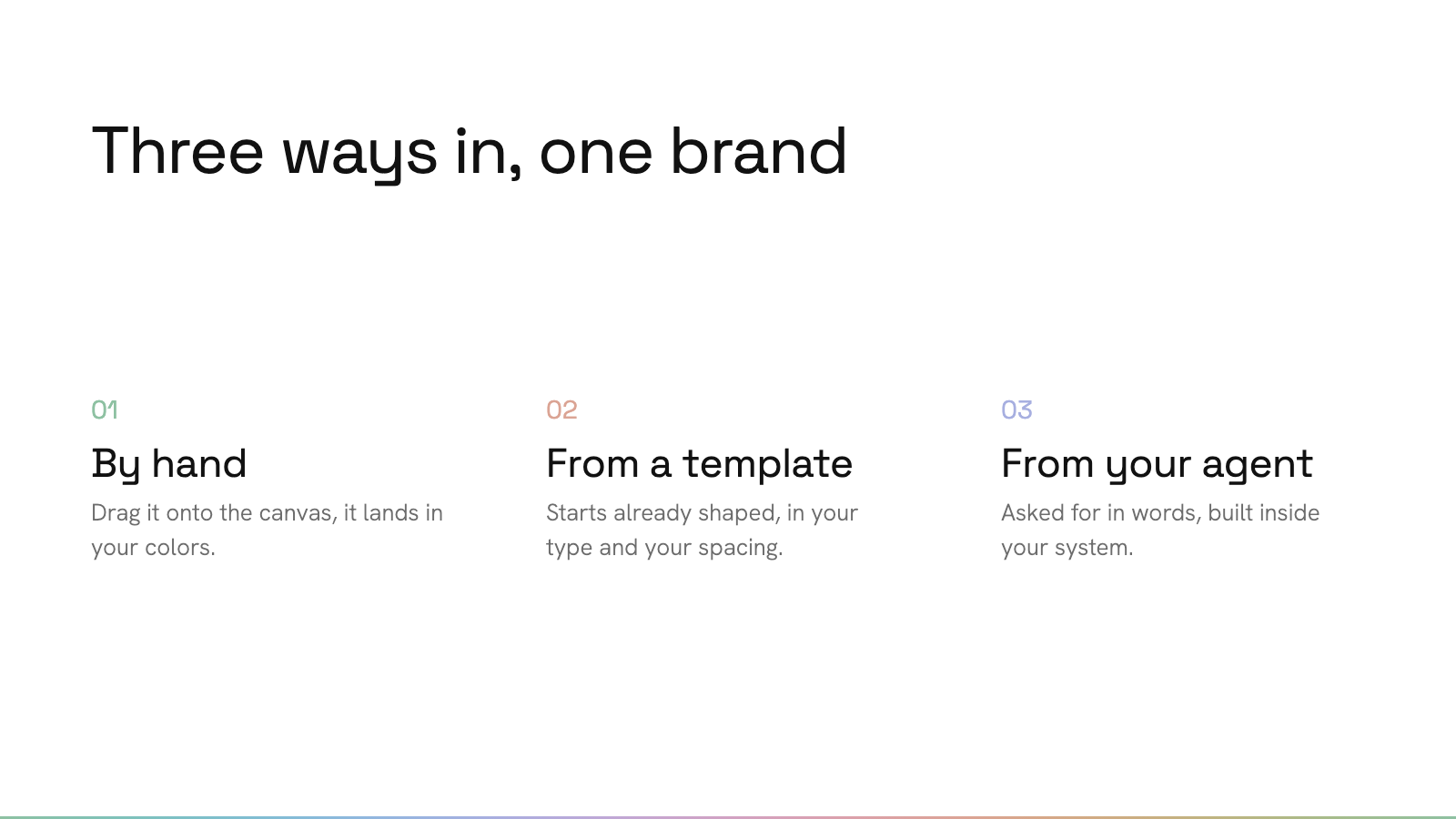
One sentence in your coding agent, in your own words. It can be a whole new slide, a whole presentation, or the single line on an existing one that has to change.
Your sentence becomes a spec: the template to use, the roles to bind, the grid to snap to, and the limits to hold. All of it in your design system's own terms.
Your agent builds from the spec. Nothing in it is left open to interpretation. Your coding agent is doing the work, not deciding what your brand looks like.
The result goes back to the brain before it goes to you. It gets checked against what you asked for and the same brand that wrote the spec, value by value.
Generated by AI, curated by you. It lands on your canvas like anything else you have made: move it, rewrite it, or ask for another pass. The loop closes when you say it closes.
Last updated September 11, 2026
Briiq is made and run by Daniel Coelho Camargo, an individual based in Brazil. In these terms, “Briiq”, “we” and “us” mean Daniel Coelho Camargo, and “you” means the person using Briiq. If you use Briiq for a company, you accept these terms on its behalf.
These terms cover your use of Briiq: the desktop app, your Briiq account and this website. By creating an account or using Briiq, you agree to them. If you don’t agree, please don’t use Briiq.
Briiq is a desktop app: a design canvas where the design and the code are one thing, dressed by your own design system. It works together with the coding agent you already use.
A subscription includes Briiq Slides, the Design System, coding agents and every update to the app. Features marked “Soon” on our site aren’t available yet. When they arrive, they’re part of the same subscription.
You sign in with a Google or GitHub account. Keep that account secure: what happens through your Briiq account is your responsibility. You must be at least 18 years old to use Briiq.
Your first 7 days are free, and we don’t ask for a card to start. When the trial ends without a subscription, Briiq goes read-only: you can still open and see your work, but you can’t edit it until you subscribe.
Briiq costs US$20 per month, or US$15 per month billed annually (US$180 per year). Depending on where you live, sales tax or VAT may be added, and you’ll see the total before you pay.
Our order process is run by our online reseller Paddle.com, which is the Merchant of Record for all our orders. When you subscribe, you buy Briiq from Paddle, under Paddle’s Buyer Terms. Paddle takes the payment, handles sales tax and invoices, and answers billing questions.
Your subscription renews automatically at the end of each month or year until you cancel. You can cancel at any time, from the link in your Paddle confirmation email or at paddle.net. Your subscription stays active until the end of the period you already paid for, and you won’t be charged again.
If we change the price, we’ll tell you before the new price applies to your subscription, and you can cancel before it does.
When a paid subscription ends, because you canceled, a payment failed or a payment was refunded, Briiq goes read-only, the same as at the end of the trial.
Refunds are covered by our Refund Policy.
What you make in Briiq is yours: your designs, your slides, your design systems and the material you bring in. We don’t claim any ownership of it.
Your work lives on your computer. Briiq’s servers keep your account and workspace details, not your files. Some features send parts of your material to our AI provider to do what you asked, as our Privacy Policy explains. You give us permission to handle your material only as far as those features need.
Because your files are on your computer, keeping backups of them is up to you.
Briiq uses AI, in its own features and through your coding agent. What AI produces can be wrong, incomplete or similar to someone else’s work. Review it before you rely on it or publish it: what you do with it is your responsibility.
We don’t claim any rights to what the AI makes for you in Briiq. As far as we’re concerned, it’s yours, like the rest of your work.
Briiq works with the coding agent you already use, such as Claude Code, running on your own account with that provider. Your use of it, and what it costs, is between you and that provider, under their terms.
If you connect Figma or GitHub, you allow Briiq to read your files there to bring your brand material in. You can disconnect them at any time. Those services have their own terms.
Don’t use Briiq to break the law or anyone’s rights, including by bringing in material you don’t have the right to use. Don’t try to break, overload or get around the security or the limits of Briiq, don’t copy or resell it, and don’t reverse engineer it except where the law allows. We may suspend or close an account that breaks these rules, and when we can, we’ll tell you first.
While your trial or subscription is active, you have a personal, non-exclusive and non-transferable right to install and use Briiq on your computers. Briiq itself, its code, design and brand, stays ours. Briiq includes open-source software that comes with its own licenses.
We keep improving Briiq, so features may change. We work to keep it running, but we can’t promise it will always be available or free of errors.
If we close your account without you breaking these terms, or if we stop offering Briiq, we’ll tell you in advance and refund the part of your subscription you paid for and didn’t get to use.
Briiq is provided “as is”. To the extent the law allows, we give no warranties beyond what these terms say, and we’re not liable for indirect or consequential losses, such as lost profits or lost data. Also to the extent the law allows, our total liability for any claim about Briiq is limited to what you paid for it in the 12 months before the claim.
If you use Briiq as a consumer, the law where you live may give you rights that a contract can’t take away. Nothing in these terms limits them.
You can stop using Briiq and delete your account at any time. What happens to your data after that is in our Privacy Policy.
We may update these terms. When a change matters, we’ll tell you by email before it takes effect. If you have a paid subscription, the new terms apply from your next renewal, and if you don’t agree with them, you can cancel before then. The date at the top shows the latest version.
If any part of these terms turns out to be invalid, the rest still applies. If we don’t enforce a term right away, we don’t give up the right to do it later. If someone else takes over Briiq, these terms can move with it, and we’ll tell you.
These terms are governed by the laws of Brazil, and disputes go to the courts of the city of São Paulo, State of São Paulo, Brazil. If you’re a consumer, you keep the protection of the mandatory laws of the country where you live, and you can also bring a claim in your local courts where the law allows it.
Questions about these terms: support@letsbriiq.it.
Last updated September 17, 2026
Briiq is made and run by Daniel Coelho Camargo, an individual based in Brazil, who is responsible for your personal data under this policy. You can reach us at support@letsbriiq.it.
You sign in with Google or GitHub. From that account, our sign-in provider receives your name, your email address and your profile photo. Your workspace is named after you by default.
When you activate Briiq on a computer, we keep an identifier for that computer and its name, so you can see where your account is in use. We email you when a new computer is activated. The app also checks your subscription about once an hour.
If you connect Figma or GitHub, we keep the access key that service gives us, encrypted, along with your Figma email or GitHub username. GitHub’s permission screen asks for access to your repositories, including private ones. Briiq only reads them, to bring your brand material in. Disconnecting a service deletes its key.
For each request to Briiq’s AI features, we record which feature ran, which model it used and how much it used. We don’t record what you asked or what came back.
We keep a log of important account events, such as connecting a service, for 90 days.
Payments are handled by Paddle, our reseller and Merchant of Record. Paddle collects your payment details under its own Privacy Policy. We never see your card number.
We don’t use your data for advertising, and we don’t make automated decisions about you that have legal or similarly important effects.
What you make in Briiq is stored on your computer, not on our servers. When you use an AI feature, such as reading your brand material, a repository, images, PDFs or text you provide, the parts it needs are sent to Anthropic, our AI provider, to produce the result. We don’t store that content, and Anthropic doesn’t use it to train its models.
Your coding agent, such as Claude Code, runs on your own account with its provider. What it sends and keeps is covered by that provider’s privacy policy, not this one.
On your computer, Briiq keeps your sign-in in your system’s secure storage, the access keys for Figma and GitHub in a file in your user folder, a history of the questions you send to your coding agent and its answers, and your drafts and preferences.
We use these providers to run Briiq, and each gets only what its job needs:
We may also share data when the law requires it. We don’t sell your data or use it for advertising.
Our servers are in Brazil. Some of our providers process data in other countries, including the United States, so your data may be handled outside the country where you live. We only send it where it’s needed to provide the service you signed up for.
We keep your account data, including the record of your AI use and the computers you’ve activated, while your account exists. The security log is kept for 90 days, and the emails you send us for as long as we need them to help you.
You can delete your account at any time in the app, under Settings, Account. Deleting it, in the app or from your account page on the web, erases right away your account, your workspace, your computers, your Figma and GitHub connections, the record of your AI use and your security log. If you tell us why you’re leaving, we keep only your answer and the date, with nothing that identifies you. Files on your computer and your GitHub repository stay yours.
Wherever you live, you can ask us whether we hold data about you, to see it or get a copy, to correct it, to delete it, to export it, and who we’ve shared it with. You can object to how we use it and, where we rely on your consent, withdraw it. Write to support@letsbriiq.it and we’ll answer within 15 days. You can also complain to the data protection authority where you live.
This website has no analytics or trackers and sets no cookies. Signing in uses the cookies our sign-in provider needs to keep you signed in and to block bots.
Briiq is for people aged 18 and over, and we don’t knowingly collect data from children.
Access keys to your connected services are encrypted on our servers. No system is perfectly secure, and if something happens that puts your data at risk, we’ll tell you.
When we change this policy in a way that matters, we’ll tell you by email before it takes effect. The date at the top shows the latest version.
Questions or requests about your data: support@letsbriiq.it.
Last updated September 11, 2026
Briiq is made by Daniel Coelho Camargo and sold through Paddle.com, our online reseller and Merchant of Record. Paddle runs the checkout, charges your card, handles sales tax and invoices, and sends refunds back to you.
This policy is our promise on top of Paddle’s Refund Policy and Buyer Terms. Where they give you more, the more generous rule applies.
Every new account starts with a 7-day free trial. We don’t ask for a card to start it, so nothing is charged during the trial, and nothing is charged when it ends unless you choose to subscribe.
You can ask for a full refund within 14 days of any payment: your first one or a renewal, monthly or annual. We refund the whole payment, not part of it.
When a payment is refunded, the subscription it paid for is canceled.
After 14 days, payments aren’t refundable, except where the law requires it.
If Paddle turns down a request made within those 14 days, write to us and we’ll make sure you get your refund.
You can cancel your subscription at any time. It stays active until the end of the period you already paid for, and you won’t be charged again. To cancel, use the “Manage subscription” link in your Paddle confirmation email, or go to paddle.net.
If the law where you live gives you a right to cancel an online purchase or to get a refund, that right still applies, and nothing in this policy reduces it. Paddle’s Refund Policy explains how it works where you live.
We may decline a refund when there is evidence of fraud or abuse.
If something went wrong with a charge, please write to us before disputing it with your bank. It’s usually the fastest way to fix it.
Write to support@letsbriiq.it.